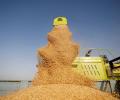
The government on September 14 further reduced the stock limit on wheat traders, wholesalers and big chain retailers to 2,000 tonnes from 3,000 tonnes with immediate effect to control wheat prices, which are showing an uptick again after being stable for some time. Announcing the move, food secretary Sanjeev Chopra said that retail prices of key essential food items, especially wheat, rice, sugar, and edible oils, were unlikely to see any sharp rise in the upcoming festival season as the country had adequate supply and the government was keeping a close vigil on hoarders.

Commerce Minister Kamal Nath on Friday announced that jet fuel supplies to long-distance flights of international carriers would be treated as exports.
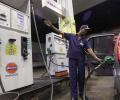
After the latest spike in crude oil prices, petrol prices could potentially go up to around Rs 90 a litre making a dent in the consumer's wallet. This, the analysts fear, will push the cost of vehicle ownership in the country, further reducing the demand potential for the industry.

Moody's Investors Service on Tuesday lowered India's GDP growth forecast for the 2020 calendar year to 5.3 per cent, on coronavirus implications on the economy. Moody's had in February projected a 5.4 per cent real GDP growth for India in 2020. This too was a downgrade from 6.6 per cent earlier forecast.

Trinamool Congress is the second highest recipient of political donations through electoral bonds.

Saudis are interested in expanding their relationship with India, given it is becoming the main driver of crude demand growth in Asia

A long term solution to reduce India's Current Account Deficit will be to increase India's share of global merchandise exports, so that we are able use our exports to fund our imports, points out Chidambaran G Iyer, Senior Fellow, Pahle India Foundation.
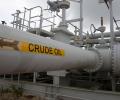
There is positive correlation between crude oil prices and Indian equities and investors can expect more upside after the recent rally in Brent crude price.

India will need to travel back in time and seek inspiration from football greats Tulsidas Balaram and Chuni Goswami to deftly dribble around and sidestep the West-imposed price cap on exports of Russian seaborne crude oil. India depends on imported oil to meet 86 per cent of its needs, of which nearly a quarter now comes from Russia. The copious flows are roughly 10 per cent cheaper than competing suppliers helping India save billions of dollars in fuel costs.

India, which imports over 80 per cent of its oil needs, spent $87.7 billion on importing 220.43 million tonne (MT) of crude oil in 2017-18. For 2018-19, the imports are pegged at almost 227 MT.

Many economists say only a substantial rise from October would point to a real recovery.
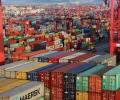
The country's exports jumped by 60.29 per cent to $34.45 billion in March even as the outbound shipments contracted by 7.26 per cent during the full 2020-21 fiscal to $290.63 billion. Imports too grew by 53.74 per cent to $48.38 billion in March, but dipped by 18 per cent to $389.18 billion during April-March 2020-21, according to the government data released on Thursday. Trade deficit during March 2021 widened to $13.93 billion from $9.98 billion in March 2020.

Saudi Arabia relies more heavily on migrant labour than any other large country.
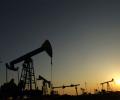
Experts say local demand, government policies in retail and refining sector are attracting foreign players.

Oil accounts for about a third of India's total imports and higher dollar prices combined with a rupee near all-time lows have increased its cost.

'It is time to allow the rupee to move towards its true value, as it is hurting Indian exports, investment and SMEs associated with export sectors that create jobs,' argues Pravakar Sahoo.
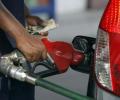
A looming global shortage of diesel in Europe presents India with more than one opportunity to profit from strong margins. A shortage of the fuel, a key contributor to inflation, has been exacerbated by the conflict in Ukraine, and western sanctions on Russian fuel supplies. The slowdown in natural gas supply means the West needs diesel to heat their homes this winter.
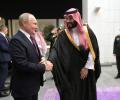
Escorted by four fighter jets, Russian President Vladimir Putin made a rare one-day lightning tour to the Middle East during which he visited Saudi Arabia after a short trip to the United Arab Emirates.
